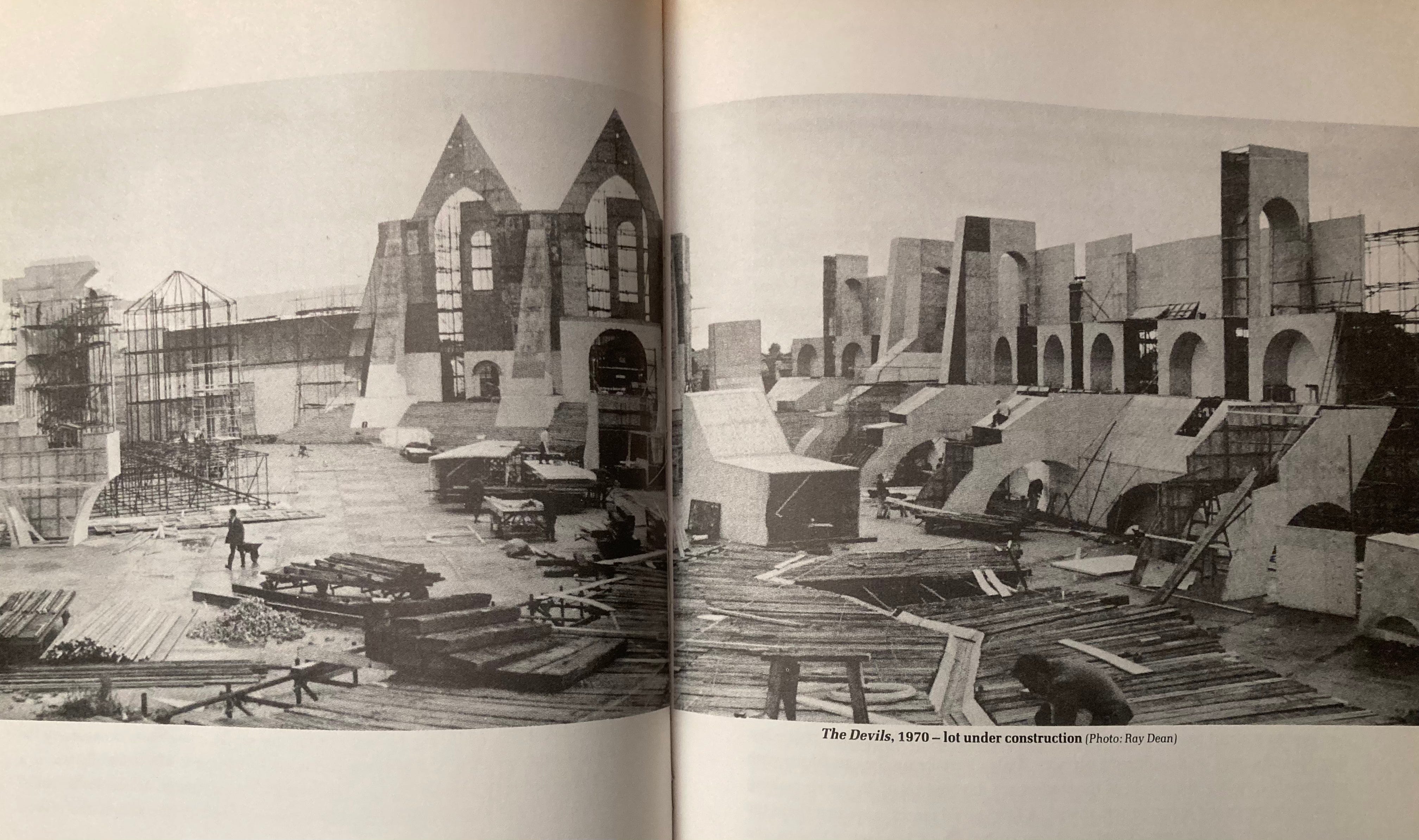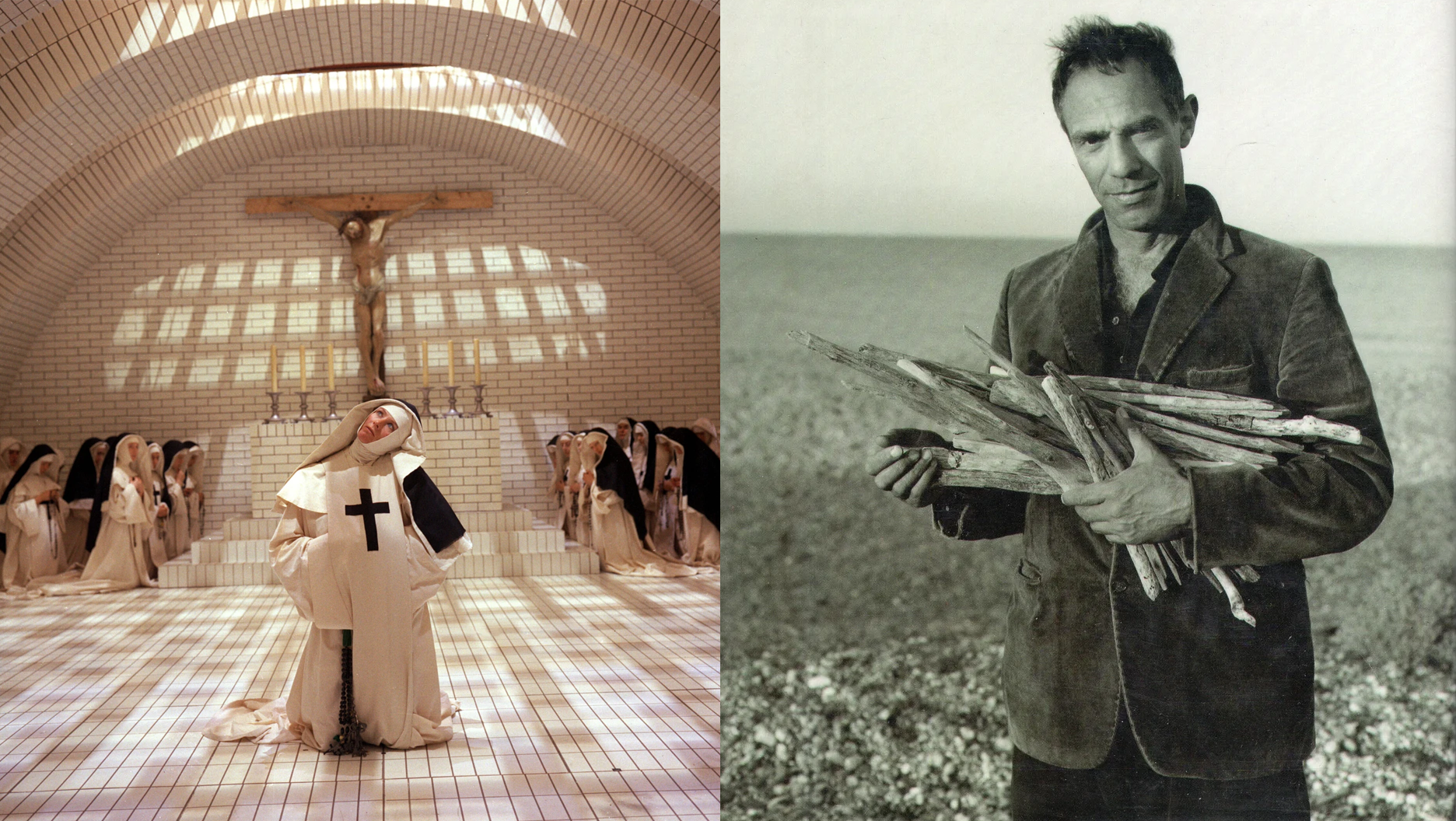
It’s The Devils, plural, for a reason. Not only was there director Ken Russell, working through the end of his faith by adapting Aldous Huxley’s novel about a medieval convent taken over by sexual hysteria. There was also Derek Jarman, plucked by chance from experimental theater anonymity to design the 1971 film’s sets. And what sets. Unlike in most films the sets became part of The Devils’ spell. In Jarman’s hands the town of Loudun is the psychogeographical model of its denizens’ madness: the white fortress walls, the tiled torture chambers, its crucifixion fields. With the 4k restoration of the uncensored version now touring, Medium Cool is excerpting Jarman’s diaries from the making of Russell’s film.
Reading these entries now I’m struck by the studio-ness of The Devils: epic sets, the department squabbles, the suit visits. It was a major co-production, making Russell’s surprise at how much the studio loathed the completed film seem genuine. “They read the bloody script didn’t they!” he was reported to have yelled. With the director later begging Jarman to design his adaptation of The Who’s Tommy, Jarman would have been poised for his Hollywood debut as a designer. He decided otherwise, and embarked on a career of his own as a resolutely independent director, video artist, discover of Tilda Swinton, and LGBTQ activist before his death in 1994. But here, back before The Devils was the most notorious studio film ever made, read about champagne-soused takes, wasps invading the production, and the director accidentally blowing up the set.
The Devils restoration screens at Lincoln Center as part of the 2026 New York Film Festival and opens in wide release on October 16th. The following are entries from Dancing Ledge, by Derek Jarman.
January 1970, Upper Ground: I was dreading coming back to London as by Christmas I had very little money and no way of heating the warehouse at Upper Ground, with the exception of the small office I’ve made of my bedroom. I can just afford to keep the ‘pither’ stove going, but it does nothing except keep the water from freezing in the lavatory. The old coke water-heater swallows up fuel, and you have to lay in at least half a ton at a time. The holiday in Excelmans [Paris] solved the problem for a couple of weeks as the fridge was well stocked and the building centrally heated. On the train waiting to return home, I noticed a girl carrying two heavy suitcases. Something about the way she was dressed and her long hair told me she was English, so I shouted out of the window that there was a spare seat in our carriage, and she clambered in. Throughout the eight-hour journey we chatted about the theatre and painting. Janet Deuter was teaching at Hornsey in the experimental light and sound department. She was a friend of Ken and Shirley Russell so she told me of their new film project, The Devils. When we parted company she told me that she’d tell Ken about me, as she was convinced we would get along.
I soon forgot about this. But a day later the phone rang and Ken asked me if he could come over — ‘Tomorrow’. OK I said. ‘I’ll be there at eight in the morning,’ and at eight he arrived in the freezing empty warehouse at Upper Ground. He was bowled over by the building and while we huddled over mugs of tea I pulled out the odd drawing from Jazz Calendar and the Don, plus various other projects I had worked on. After looking at them briefly he asked me to design The Devils. I was quite taken aback by the suddenness of this offer, as I’d promised myself that after Don Giovanni I would never design again. I asked him if I could think it over, and he gave me twenty-four hours. ‘In the meantime can Shirley come to tea to meet you?’ In the evening I rushed out to see Women In Love. On the strength of that, and conversations with a few friends, I decided to plunge in...
February 1970 Ladbroke Grove: I sit up stairs on the livingroom floor among the bric-a-brac which invades every corner of Ken’s home. His latest addition is a portrait of Hedy Lamarr. Shirley makes coffee while Ken and I thrash out ideas. My architectural history, the years with Pevsner, stand me in good stead.
The town of Loudun is an enormous task. There’s the exterior as well as the interiors to consider, and also a large number of sets for Louis XIII’s court in Paris. I’ve brought a bottle of sepia ink ink and the finest rapidograph, which I use to make meticulous drawings of the sets, stone by stone, after initial (very rough) sketches. An art director, George Lack, is drawing these up into proper plans and elevations, and students at the Central are building a scale model of the exterior.
The whole lot is to be built at Pinewood. My source books are Ledoux, Boulee and Piranci’s prison series. All detail is sacrificed to scale as I want the sets as large as possible, and as forceful as the sets from an old silent.
May 1970, Pinewood: The journey out to Pinewood Studios is a nightmare. I’m usually up by 5.30 to get there by 8.30. So much of the time is spent waiting for trains and in the evening it’s worse unless I manage to hitch a lift. Yesterday I came out with Ken in the white Rolls for a meeting with the American investors — a gang of Hollywood mafia, who took the model of Loudun up to the lot where it was dismembered with a breadknife while they argued about its size. They posted studio assistants to mark its limits on the ground. They spent half an hour dissecting three months’ work, and at one point attempted to jettison the cathedral. The set is apparently going to be the largest since the ill-fated Cleopatra. Later, Ken called to say he’d been battling with them all day. Although he’s saved Loudun, we’ve lost the sets for Louis XIII’s palace, except for the theatre and perhaps the library; so the original design will never be realized — a historical film shot entirely in sets.
17 August 1970, Pinewood: We started filming after months of preparation. The great white city is nearly complete on the lot and has become a tourist attraction. You could almost pay for it with visitors’ fees. It cost £97,000. The finish of the white machine bricks (rather than the stone of the drawings) was decided upon in the plaster-rooms where they have brick and stone moulds of every description. I had various sections painted with more usual brick colors — yellows and reds — but looked dowdy on the glittery surfaces. Today we take up the catafalque with its shrouded figures: the whole of the studios are devoted to us as we’re making most of the props and furniture as well. A few special pieces, amongst them the life size crucifixes of the nuns’ chapel, are being sculpted by Christopher Hobbs; the crucifix is from the Isenheim altar (in polystyrene with a gesso finish). We found an authentic sixteenth century brank, a skull mask made in limewood. It’s in fragments but we’re going to restore it for the burning sequence, for which Christopher is also making a half burnt Oliver Reed out of latex.
The bald nuns have caused quite a stir. At first they refused to have their hair cut off, but the producer bribed them with an offer of 150 pounds and two wigs each.
September 1970, Northwood: I just picked up the tail-end of a conversation between my parents, who are washing up in the kitchen having insisted on me leaving it to them. Whatever Dad had said, Ma replied, ‘I’m so glad our children haven’t grown up normal, they’re so much more interesting than their friends.’
Lunch with Max Adrian, which brightens up the day no end. I found him in bed with the lady who is covered with the most revolting plague sores, eating a sandwich lunch on set. He said why didn’t I join them, as she couldn’t go to the restaurant looking like that: it would put everyone quite off their food. Max sat at lunch today eating cherry pie surrounded by empty plates. When I asked him what the plates were for he said, ‘For the bones.’ He recalled that at his twenty-first birthday party his mother looked him up and down and said, ‘Max, you are really quite ugly but at least you’re clean.’
Work is a minefield: the courtiers came down to the set this morning with horrible plastic roses in their hair. I told them to take them out, which most of them did quite willingly— but alas I didn’t know that the designer’s powers do not stretch to hair and a dispute began which came within an hour’s breadth of stopping the film. The whole thing was conducted with the utmost pettiness. The extras can be as stubborn as mules. They insist on wearing watches, never take off their rings and carry newspapers around with them, which come out the moment Ken shouts ‘Cut!’
Rushes are like bingo. Each of us votes for his favourite — one, three, four or whatever. Ken sits at the back with the lighting cameraman, David Watkins, who usually gets his way. Watkins, who always wears plimsolls, reminds me of a bad-tempered sportsmaster. One expects him to take out a whistle and blow it. He doesn’t like me very much, probably because everyone calls me ‘the artist’ and the sets, rather than his lighting, are the continual topic of conversation.
Today, Charlton Heston was sitting in the projection-room — he has a hide like tanned leather.
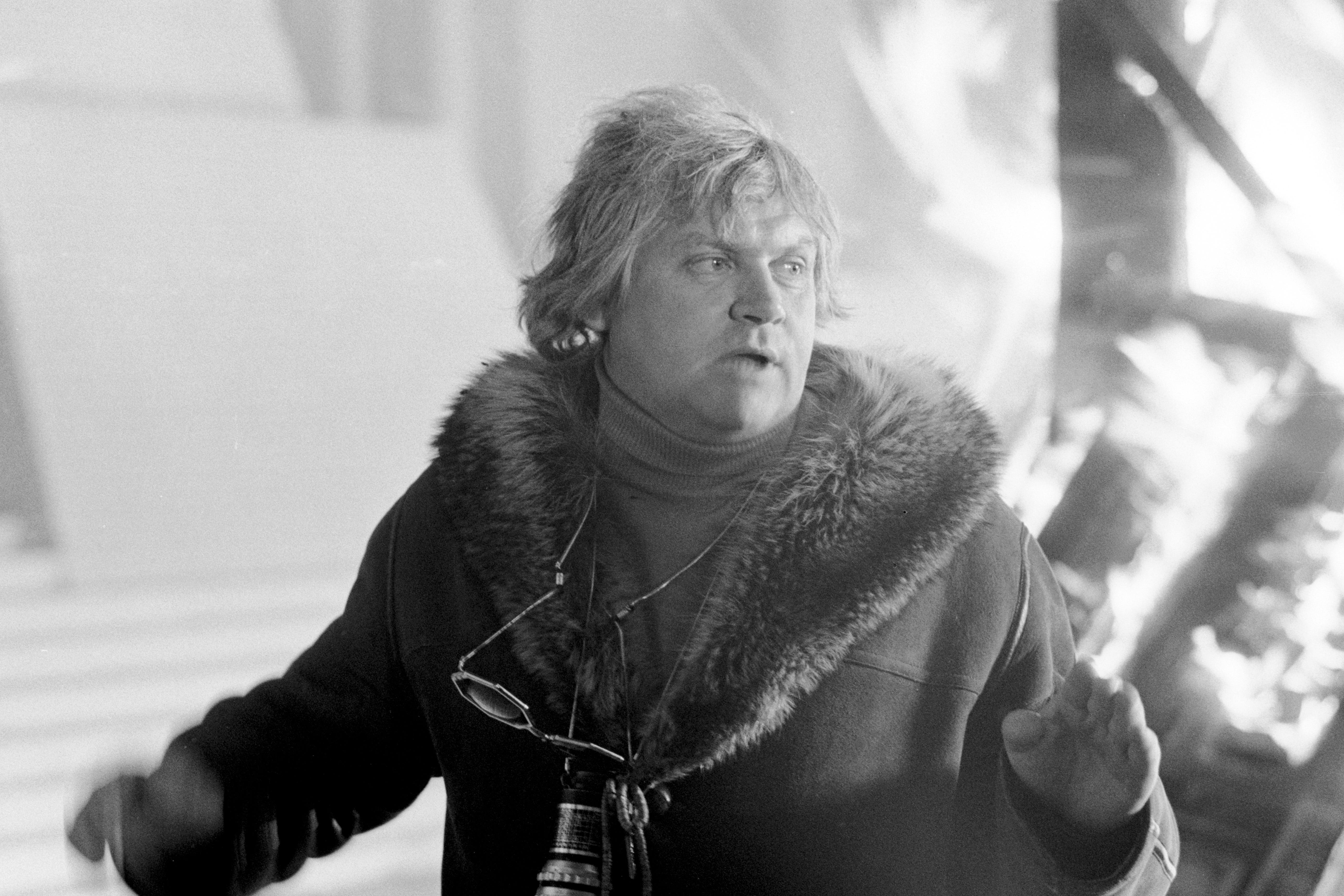
Revolting afternoon at the plague pit: it is composed of dummies and extras made up as corpses. Ian laid in gallons of real blood from the abattoir — splashed all over the place, it attracted clouds of wasps which made it almost impossible to act dead. Ken, as usual, stormed around, the bodies shifting as a wasp flew too close even when the cameras were turning. Nothing was right; the blood was a disaster. In the end he made me bring bottles of ketchup from the kitchens, which made everything worse as the wasps preferred it to the real thing. There was a huge row this morning about the houses on the lot. I’d taken down some shutters without consulting Ken. He’d seen them at an early stage of the design, and was expecting them on the buildings. ‘I can’t trust you, I can’t trust you. In future you’ re going to bring me everything to be signed.’ He looked like the mad empress from some B movie — waving his cane, his long hair flowing, wearing a smock and enormous rings on every finger. He left the set shouting to the air, everyone looking at each other rather embarrassed. I quietly carried on and tried to ignore the whole affair.
October 1970, Pinewood: The wilder scenes in the film are fueled with champagne, which sometimes arrives with breakfast. In the cathedral Ken has a drum-kit
brought in and drums away loudly to whip up fervour. The set is closed, and there are wild rumours all over the studio about ‘orgies’.
I’m back at Bankside every night, exhausted, often as late as ten. I’m up at 5.30 to reach the set by 7.30. Ian Whittaker picks me up in his car, on Southwark Bridge, bleary-eyed at about six. I work most Saturdays and often Sunday. Life as I knew it has ceased to exist.
May-September 1970, Ladbroke Grove: Ken asked me what would most upset an English audience. Louis XIII dining al fresco, carelessly shooting peacocks on the lawn between courses. ‘Impossible,’ said Ken. ‘How would you do that?’ ‘Make some dummies, stand them on the lawn and detonate them. ‘No, you’d have to shoot real peacocks. It wouldn’t work otherwise.’
Later, this scene crept into the film in the garden at Pinewood. Ken dressed his Huguenot extras as blackbirds, which the king shot while nonchalantly talking to Richelieu. At one moment our Louis said campily, ‘Bye, bye blackbird.’ ‘Marvellous,’ said Ken. ‘What do you think of that, Derek?’
‘Oh I suppose it’s OK,’ I said half-heartedly. I didn’t want to be the kill-joy. The idea had transformed from the steely, vicious concentration of a scene from The White Devil to a farce. ‘Do it again,’ said Ken, and into the film it went. My sensibilities about what was appropriate were violated. A flip joke in a nasty little garden at Pinewood, instead of a great abstract topiary set with strutting peacocks. In a very dark mood I returned to Bankside.
December 1970, Pinewood: Ken and his camera crew were tempers frayed come the end of filming in December. When the day for the great detonation of the walls of Loudun arrived, when all the charges were laid and we were ready to go; Ken, who had been very moody, said, ‘I’m not having this fucked up’ and climbed on to the camera to film it himself. The signals that had been organized to let the explosives experts know we were rolling were primitive; and Ken, waving his arms in the argument around the camera, set the whole lot off. The camera stood idle, and as the dust and debris descended from the massive explosion everyone stood around dumbfounded. The next ten days were spent restoring the walls to get the shot.
Almost every waking moment of 1970 was spent working on The Devils. When I began in January I had no idea that a film of this size completely usurps your life. And by the time I emerged from Pinewood in December, the easy life of the sixties — designing and painting — had gone for ever. It was now impossible to pick up all the threads. Painting was the major victim: I continued it over the next ten years very sporadically. After the intense pressure under which a film is made, it seemed undemanding — and the isolation in which it was pursued, enervating. However, in the autumn the first of my own films took off with the help of Malcolm Leigh; to be followed by a whole series of Super 8s which gradually, without my realizing it, relocated my work. Although much of my time at Pinewood was spent in the constructions of sets, every now and then my presence on the set was necessary. In fact, Ken attempted to keep me there full-time; and I discovered (imperceptibly) how a feature film ran. There was no better director to learn from, as he would always take the adventurous path even at the expense of coherence.