
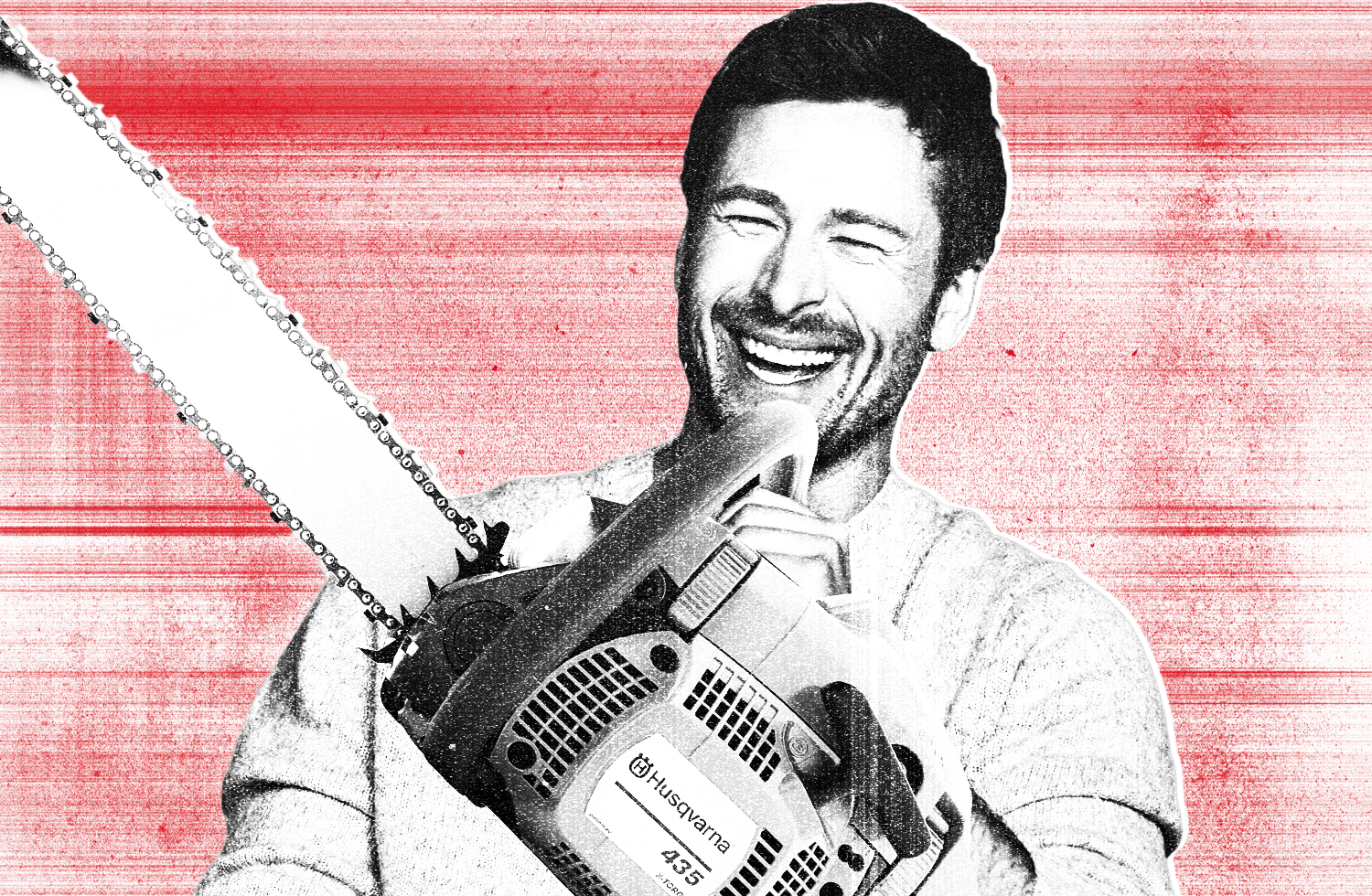
When Emily Met Leatherface
Watching Emily Watch Texas Chainsaw Massacre For The First Time
When A24 announced last month they were rebooting The Texas Chainsaw Massacre into several properties to be developed by Glen Powell, it came out in conversation that Emily Schultz had never seen Tobe Hooper’s 1974 film.
I think “film” is reductive here in describing Chainsaw. It’s more like Hooper weaponized experimental cinema and soundscapes to trap us in the worst day of anyone’s life, all to chronicle the downfall of the American dream. It’s an experiment in creating antimatter that has never been replicated. When Emily suggested Chainsaw as a Cinema Dirtbag commentary, I demurred. I thought maybe Emily was a better person for having never seen it. Then I watched Chain Reactions, a fascinating documentary that interviews superfans Patton Oswalt, Karyn Kusama, Takashi Miike, Stephen King, and critic Alexandra Heller-Nicholas— the film writer who has most altered my way of thinking about genre over the years.
Heller-Nicholas recalled the gatekeeping she experienced as a young girl, how boys thought she could never handle Chainsaw and when she did watch it she realized, “This is for me too.” Having now called myself out on the fact I was replicating that gatekeeping with Emily, I cued up a destroyed 35mm grind house scan of The Texas Chainsaw Massacre. (One of the cooler special features of Dark Sky’s blu-ray of Chain Reactions.)
In the words of the film’s tagline, who will survive and what will be left of them? Read on to find out.
EMILY SCHULTZ: I should say that I did see the ending of Texas Chainsaw Massacre—I walked in on my brother watching it and he was like: This isn’t for you! And I was banished out of the room.
BRIAN J DAVIS: And that is exactly what Heller-Nicholas was talking about! It’s almost “This isn’t for you Dewy” from Walk Hard. Now, the interesting thing is your novel Little Threats—can we do spoilers five years on?
ES: Sure.
BJD: It ends with a chainsaw accident! A sudden, shocking comeuppance by chainsaw if you will. And if I recall, this was never mentioned in any review!
ES: The only person who mentioned it was one of my ex-girlfriends! She liked it. She is also Australian. But I will say, I do think the imagery from that one brief glimpse at age ten stayed with me—enough to creep into my work.
BJD: I lucked out in that I didn’t see Texas Chainsaw Massacre until I was like, a solid fifteen. And I could actually appreciate the weird artistry of it and why Tobe Hooper was doing what he was doing. By fifteen, I’d seen Stan Brakhage movies from the library and taken out Edgard Varèse albums.
ES: I don’t think I saw Stan Brakhage movies until my late twenties.
BJD: These are just the facts of a Brian conversation—I’m going to drop shit like that. But Tobe Hooper was an underground hippie filmmaker in Austin. His film before this was called Eggshells and it is a beautiful, tedious, mix of James Broughton and Brakhage, set at a commune. And it was actually filmed in the same house as the nightmare family house in Chainsaw. I recommend watching it to see an almost mirror reverse film. But they wanted to make money, a PG horror movie that could play drive-ins.
ES: So it’s kind of like when we try to sell out. It goes bizarrely wrong?
BJD: Exactly. And they’re vegetarians also. And they think, “Wouldn’t it be funny if people were treated like cattle?”
ES: I imagine that humor doesn’t come through?
BJD: It does not. There’s not a lot of onscreen violence in it because they really were aiming for PG. The violence ended up in the filmmaking itself.
ES: And my impression, having not seen it, I always assumed that this was going to be the goriest movie there is.
BJD: So I wonder for you if this is going to be like how I didn’t see Citizen Kane until I was thirty-five?
ES: You didn’t. That’s right. I came from a black-and-white household.
BJD: And I realized there’s nothing in Citizen Kane that has not been picked to the bones.
ES: Oh, speaking of which, it’s a dug-up corpse. Well, this would have frightened me at the time.
BJD: Essentially what they did is they combined the story of Ed Gein with the Manson family, and ambient 1960s anger still lingering.
ES: Okay, this is an art movie.
BJD: Shots of solar storms, that atonal soundtrack. They’re getting at some Herzog-ian take on nature. That everything is chaos and terror or…maybe it’s just really sunny in Texas.
ES: This is going to be a talkie movie, is it?
BJD: All human communication and rationality will leave this film soon so ask your questions now.
ES: Okay, I’m getting ready for it. Oh, no.
[The Hitchhiker starts cutting his wrist and performs rituals in the van.]
BJD: Oh, you lived through the ’90s. In ’94, the Hitchhiker would have been an opening act in Lollapalooza. He would have had a spoken word album on Sub Pop.
ES: He’s gonna keep the picture in his mojo bag.
BJD: Being photographed is tantamount to being cursed, so therefore everyone in this movie is now cursed.
ES: Why did the Hitchhiker take such a disliking to Franklin in particular?
BJD: I think you just had a player-know-player moment. Why are insane people really attracted to you the most?
ES: Well, Franklin was the nice one making conversation with him. I feel like this could be a Flannery O’Connor short story.
BJD: Good catch. Like in a Flannery O’Connor story, there is a morality to this movie. Just not an easily recognizable one.
ES: Could you have a more obvious butt shot?
BJD: That’s not even the most famous butt shot in the movie.
ES: I just don’t understand why Franklin didn’t get out to wash off the cut.
BJD: Come on. We’ve toured a lot. Have you ever been to a gas station that makes you feel dirtier after using it?
ES: I forgot about Lodi, New Jersey.
BJD: As you can see, this is really a landscape movie. Like a Herzog or Terrence Malick film.
ES: It feels like it’s unfolding in real time. That’s adding to the immersion.
BJD: Time is how Tobe Hooper messes with us the most. Going from the pastoral pacing to well…we’ll get there. But as an adult, I see how bold a decision it was to have a disabled character in this movie. He’s experiencing a different movie than the rest are, and we’re feeling it.
ES: A built-in empathy?
BJD: I don’t want to ascribe empathy to this movie. I don’t think that’s one of the qualities! But I love Franklin. He’s the actor here who should have been a star.
ES: He’s starting to get paranoid about the symbols surrounding him.
BJD: He’s the only one reading the scene.
ES: You know, I have stopped at a farmer’s shed to get gas.
BJD: Like this hippie about to die?
ES: Yes. The guy that I was with, he was driving his mother’s vehicle, and the gas gauge wasn’t working properly, so we ran out of gas. And we had to go to a strange farmhouse.
BJD: And how’d that transaction go?
ES: Well, I just stayed in the car.
BJD: Smart!
ES: The tooth falling? Oh, that’s great. That’s creepy. They’re not going to get gas and then go see Macbeth like I did.
I’d much rather be traumatized by art than people. In fact, traumatizing myself with art over decades has taught me how to avoid being traumatized by people.
ES: I guess I’m not talking anymore.
BJD: I just was enjoying you being speechless during the scene. The first installation art murder set in film.
ES: Oh my God. Well, this is fucking terrifying.
BJD: They thought “As long as we don’t show much blood, we’ll get a PG rating.”
ES: They didn’t get a PG rating did they?
BJD: No, they did not.
ES: Not the guy who looks like Fred from Scooby-Doo! Before he goes into the house, he has to find something that will make him pause.
BJD: So I see the movie is now officially playing you like a piano…made of bones.
ES: I know! Even though I know exactly what will happen next I’m still “I really hope he doesn’t go into the house.”
BJD: I like to consider this movie from Leatherface’s perspective. As a few people have pointed out, it is a home invasion movie from his perspective and he’s just trying to survive. I think that’s part of the Flannery O’Connor vibe you’re picking up on.
ES: But he had that little feature wall with antlers drawing people in too.
BJD: Gunnar Hansen was the actor who played Leatherface. He was a local poet and really took the role seriously and he actually volunteered at a home for autistic adults to study their mannerisms. And the performance hits me a little different as an adult.
ES: As a parent now with some knowledge and understanding of autism, you can see that he’s playing it as if he’s dysregulated.
BJD: Exactly. And I accept that as part of the all-around discomfort of this film. Like you have to process the discomfort of watching this as a woman. But in most other films where it’s done lazily, it’s something I can’t stand anymore—the horror trope of the disabled child becoming a monster or killer.
ES: Was the idea of disability a discussion during the filmmaking?
BJD: I don’t think so. I think when you’re operating from a place of originality, things are going to happen, because you let them. We like to think there’s a grand plan to original, maverick art but it’s just that the people who made them were open to doing things differently.
ES: I have to ask you, since we’re watching a horror movie and she just ran away while her brother was getting cut up, what would you do? Would you run?
BJD: I think any Texan can see a chainsaw sticking out of someone and declare “Ain’t no intervention here.” Wait. Are you calling Sally “yeller” for running?
ES: I’m just saying, do you run towards the chainsaw or away from the chainsaw?
BJD: That’s the choice in life. Either you run towards the chainsaw or you run away from the chainsaw.
ES: So wait, she’s running to the house, not knowing what’s inside. So this is like the original slasher?
BJD: That’s debatable. I would say that Mario Bava’s Bay of Blood is the first. But this is definitely the first Final Girl.
ES: She’s got lots of pans in there though. I’m like, Get yourself a pan, girl.
BJD: See, you have the wisdom of fifty years of Final Girls to draw on. You read that frame in a primal second and said “Cast iron will kill. Check. Chili will scald an attacker. Check.”
ES: What is the radio saying…?
BJD: The radio throughout is nothing but murder news. Hooper is using every avant-garde technique, all of the senses, to alter our consciousness while watching. And of course a part of this was that there was terror in the production: 18-hour days, 90 degrees at night plus these hot tungsten film lights, in a house full of scavenged roadkill.
ES: Hear me out. Wouldn’t it be nice if he just tied her up, put her in a burlap sack to subdue her so that he can drive her out of here so that Leatherface doesn’t know that he’s got somebody in the truck with him?
BJD: Are you fantasizing about a happier ending? That’s the bargaining stage.
ES: Oh, is that the guy that they picked up? Wait, he’s not going to turn around and be a hero, is he?
BJD: No hope. Sorry.
ES: You had said earlier, quoting the critic, that boys would tell girls they couldn’t watch this movie. And that happened with my own brother. I kind of get that now during this dinner scene. The usual slasher films fall within my understanding of teenage horror movies. In this, you’re in a real nightmare. Which maybe you don’t want to know that feeling?
BJD: I kind of do. I’d much rather be traumatized by art than people. In fact, traumatizing myself with art over decades has taught me how to avoid being traumatized by people. Look, they’re bringing Grandpa down.
ES: Oh, that’s creepy. Everything in this movie is so creepy. Is she tied over top of another person?
BJD: She’s in an armchair made of arms. I’ve always likened this movie to that time I did PCP by mistake, thinking it was mescaline, but then I just kind of committed to it. Not an easy experience, but holy shit was it a trip.
ES: Oh, okay. Second window jump!
BJD: Admit it, if they did a third window crash it would have been hilarious. She’d be like, “Damn. I am good at jumping through glass windows.” But now, the artifice of filmmaking is coming back after that dinner scene.
ES: When I first walked in on the ending, I came in on that scene where Leatherface’s leg gets cut. And is that how this ends? She’s escaping in the back of truck, but now insane and he’s dancing with the chainsaw?
BJD: It’s a nice touch isn’t it?
ES: Holy shit. Just holy shit.
[After some processing time.]
ES: I would say it’s a very unique horror movie in that it does capture the psychotic violence that takes place in America that you’re always hoping you’ll never encounter. And I think that’s why I felt it so much at the end from her perspective, because this is your fucking nightmare. That you’re going to be captured, tortured and nearly killed, screaming in the back of a truck, being driven away after a night of terror. But let me ask, how was it to watch the movie with someone who hadn’t seen it before?
BJD: Exactly what I thought would happen happened. The film is kind of weird at first, and kind of stoner-ish and real-time, which let us make jokes with a false sense of security. And that would slowly fade away as the utter terror of the movie took over. So, hypothesis proven. Conclusion?
ES: Well, at least I can say I’ve now seen the Texas Chainsaw Massacre.


