




Even after 16 years of living in New York City and seeing it all, we can admit it: 2026 has been a tough one for Canadian-American relations. When looking for a movie that we could riff on, and explore our alienated expat condition, Atom Egoyan’s 1994 breakthrough film Exotica seemed the perfect pick. Set in a tattered and otherworldly Toronto strip club, Egoyan took a narrative leap from his early experimental films to tell the story of a dancer, an emcee, a customer, and the horrific crime that connects them. With an incredible all-Canadian cast of Mia Kirshner, Elias Koteas, Bruce Greenwood, Victor Garber, and a teenage Sarah Polley, Exotica propelled Egoyan to his next film, the Oscar-nominated The Sweet Hereafter. As we dug in, we realized that researching the human condition at a strip club was a very Canadian pursuit. After all, Emily and I came of age in Canada’s sin city, surrounded by the sex industry, and the knowledge of where those loonies and twoonies really get to, eh.
Brian J Davis: Welcome to Canada, the world’s biggest small town with secrets!
Emily Schultz: So we’re going to have to think about what’s popular in Canada in 1994.
BJD: Well, let’s see: murder, Quebec separatism, and Mia Kirshner! At the time, this would have been my last year of high school. My best lesbian friend brought me to see Exotica.
ES: That tracks with you.
BJD: Because she was obsessed with Mia Kirshner! Because of Love and Human Remains.
ES: What’s funny is I saw that movie on a date. But I never saw Exotica until this year.
BJD: And of special note: Exotica was such a hit in Canada that it played in IMAX.
ES: In IMAX?
BJD: Yes! The first time I saw this, I felt the stories were too disconnected. But on subsequent viewings, it’s amazing, because what starts off as inscrutable for the viewer is actually quite rewarding. A lot of other people forget to put their puzzles together. You can see this in the literature as well.
ES: Linked short stories, except actually they’re not linked.
BJD: As an adult, this movie is so fucking good. But we should pause and explain why we’re going to sound like strip club experts. My family is from Windsor, Ontario, and Emily and I both ended up going to school there. It’s a very unique, rust-belt border town tethered to Detroit. Windsor had at the time, per capita, the most strip clubs in the world.
ES: Enough that years later it still got an “all nude” shoutout on the Kroll Show.
BJD: All nude is legal there, and the drinking age is 12.
ES: It’s 19!
BJD: But it was a San Diego/Tijuana set-up with an American student invasion every weekend. All this meant everyone there knew someone who danced. You lived with someone who danced, or someone’s mom was a dancer. You’d go to someone’s home and there’d be G-strings drying everywhere. What Americans call the sex industry... In Windsor, or Montreal, it’s just industry!
ES: Even my first gynecologist in New York said, “I went to University of Michigan. I remember Windsor.”
BJD: Arghh!
ES: What’s funny is the first time I went to a strip club in Canada I was told to get American singles because...
BJD: Because loonies and twoonies shouldn’t be thrown at humans! Okay, one girl I dated in college had a roommate who danced at the gay clubs, but had to quit because he couldn’t stand customers trying to tuck loonies between his butt cheeks!
ES: That’s terrible. How could you even dance?
BJD: Carefully. I hope Americans never look at their change from Tim Horton’s in the same way again. Much like Atom Egoyan wants you to look at strip clubs in a different way!
ES: And rituals. We’re watching performances within performances, right?
BJD: These people are all traumatized and performing through their trauma. You have Elias Koteas as the emcee, he’s the most revolting character in the movie. Then there’s the owner, Arsinée Khanjian, and Mia Kirshner, in a schoolgirl outfit dancing to Leonard Cohen’s “Everybody Knows.”
ES: It’s not really what you think of when you think of strip club music.
BJD: My cousin dated a dancer whose signature song was “The Hanging Garden” by The Cure. A mournful drone song about animals dying after mating.
ES: And she got away with it?
BJD: Canada!
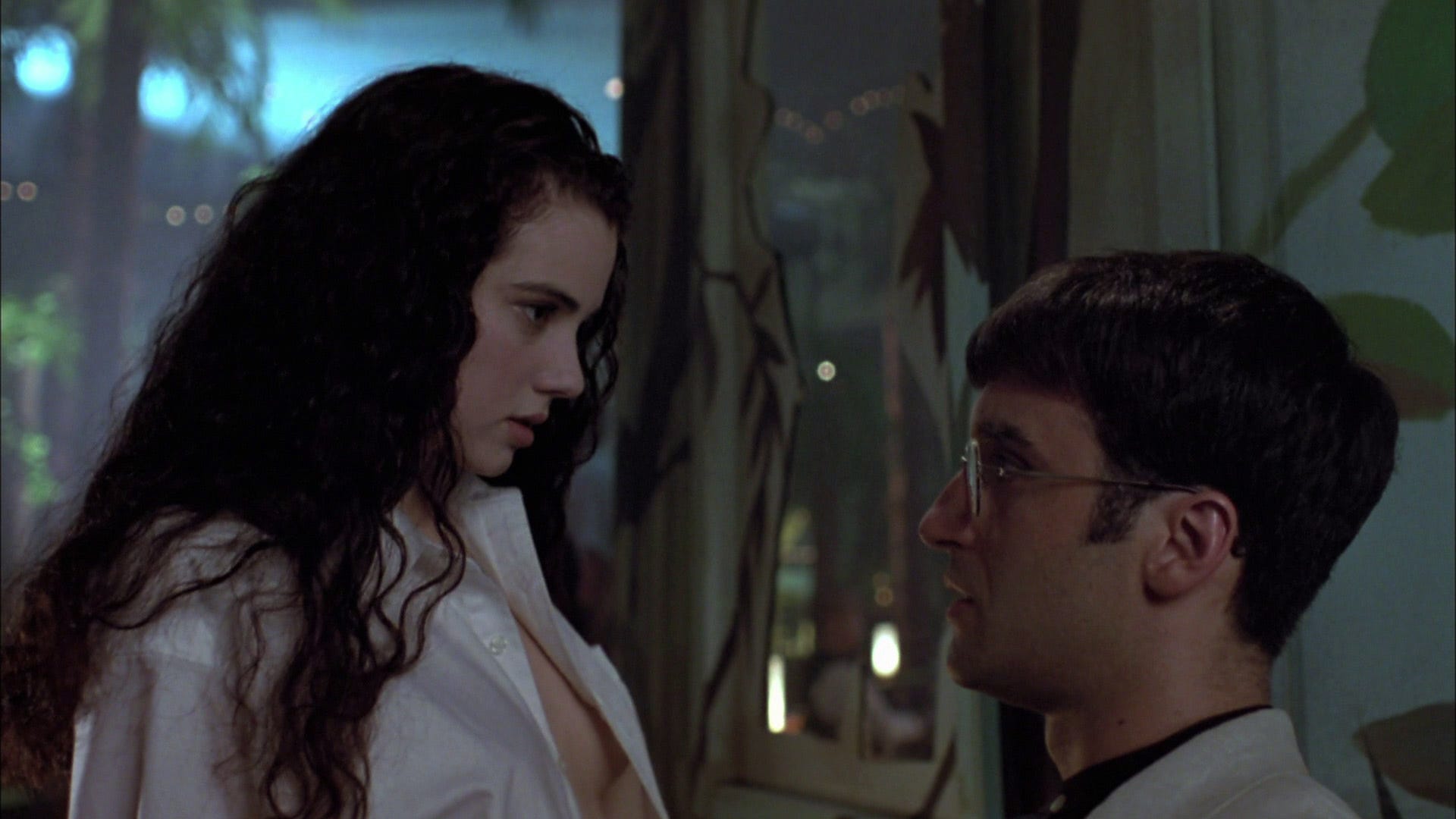
ES: Exotica is a tough watch, all this male gazing. But then there’s the owner of the club. A woman in control of things, and also watching.
BJD: And the emcee is the unreliable narrator of it all. Here’s customer Bruce Greenwood dropping off a young Sarah Polley.
ES: She lives above a roti restaurant. For a moment I was: I miss Toronto roti. But then I thought: wait, what’s going on? Because it’s 14-year-old Sarah Polley in a car being paid by Bruce Greenwood.
BJD: We’ll what’s going on is different from our expectations. But how do you like sleight of hand as a viewer? Because I know you love it as a writer.
ES: I do love it as a writer because I’m the one getting to play with your expectation. Maybe I have to acknowledge that my squeamishness here is intended, right?
BJD: Definitely. Now, you are an Elias Koteas fan?
ES: I am. Wig or no wig! What’s really great about this scene with him and the owner is in movies you usually have women that are the wrong amount of pregnant for what the story requires. And in this, because she was pregnant, it’s so accurate.
BJD: Egoyan has talked about how his one regret was he didn’t realize the effect it would have on his wife, Arsinée Khanjian, to be in a strip club full of naked women for two months while pregnant.
ES: That’s a lot. But here’s how matriarchal those clubs can be. I had an assistant editor at a magazine I ran. They came out as queer after visiting their mom’s strip club for the first time at age 19, when they were swarmed by naked French-Canadian dancers kissing them and cooing “Bebe.” They were like, yep, this is it.
BJD: Now Bruce Greenwood, the club customer, is investigating Don McKellar, the pet shop owner and animal smuggler, and the story starts to twist together. I don’t want to get into a dicey territory, but Canada Revenue is not the IRS. Canada Revenue is closer to the FBI. They are that intense. In Canada, not only do you know a dancer or someone who’s worked in a strip club, you also know someone who’s been audited. Emily?
ES: I don’t want to talk about it.
BJD: But this plays into a solid piece of writing advice. Every character should have a job that fits their obsession or neuroses. Don McKellar is all about secrecy. He’s a closeted wildlife smuggler. And Bruce Greenwood’s an auditor who can’t accept his daughter has been murdered. So he goes through these motions of having a babysitter. Or going to visit his daughter’s former babysitter at a strip club.
ES: This is someone who investigates, but who can’t accept tragedy. And now we see how Koteas and Kirshner met: at a search party.
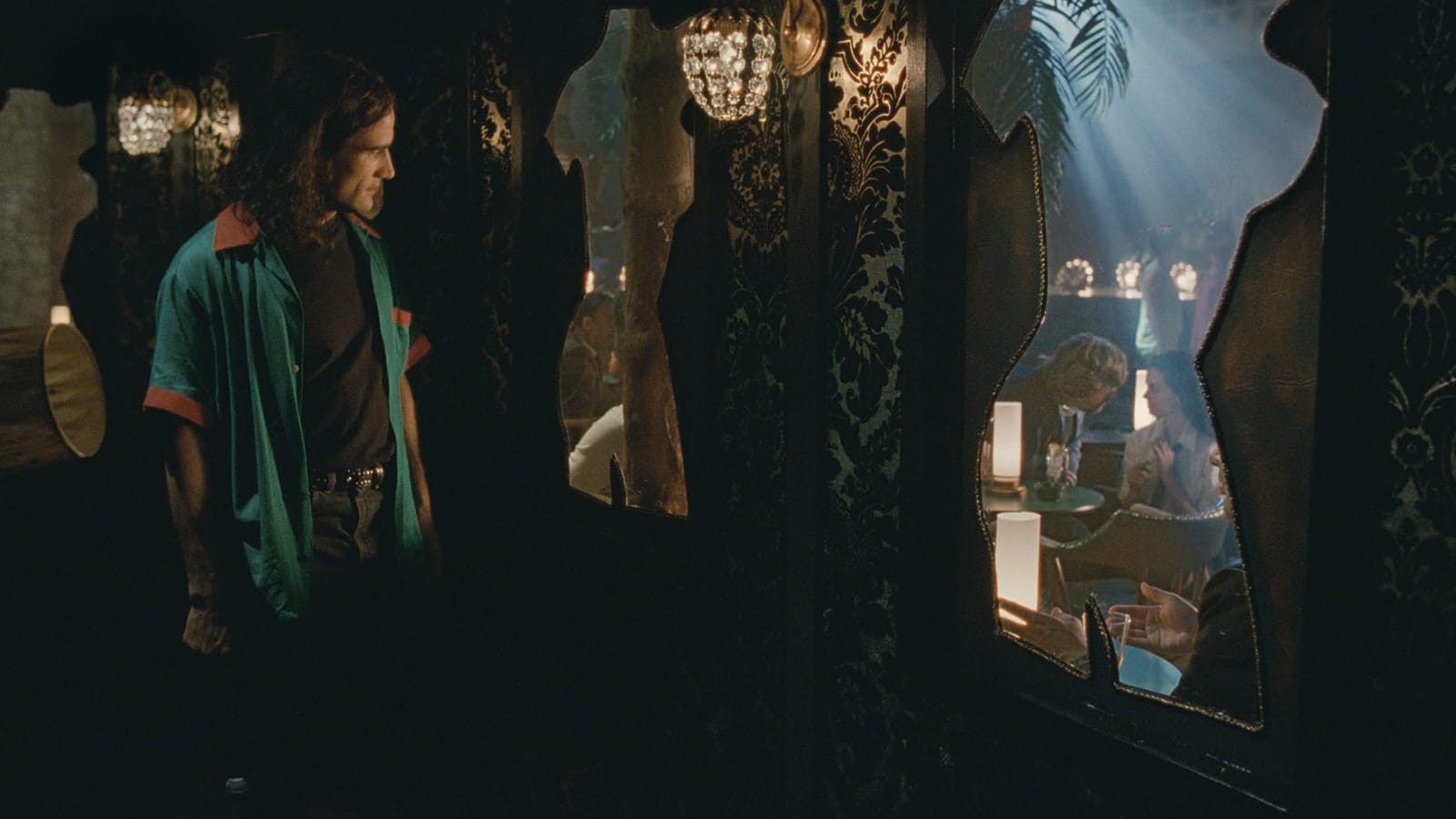
BJD: So I guess I’m going to talk a little bit about the Bernardo and Homolka case here. Delicately, because I don’t want to ascribe any intention to Egoyan that wasn’t there. This is completely me just comparing dates. But for the two years before this movie, murdered schoolgirls had haunted Ontario. Then, while Egoyan was writing this screenplay, Bernardo was arrested. So there is something powerfully evil in the air at the time.
ES: That also maybe plays into my apprehension when watching this film. It’s still a haunting case for me because I was the same age as the girls.
BJD: Grade 13?
ES: I was not in grade 13. I fast-tracked.
BJD: Canadian brag! I still want to unpack that discomfort because I feel Canada, and specifically Ontario, has since memory holed anything to do with Bernardo and Homolka because of the collective guilt over how the police and prosecution messed up the case. To quote author Kirk Makin, “There is probably only one convicted serial killer living free in the world and that’s Karla Homolka.” I believe that’s why Canada decided: We’re never going to talk about it again. Canadians take the failings of the state personally.
ES: Right, with the protests later against American Psycho being filmed in Toronto.
BJD: I was marginally on that crew as a less-than-PA! I was on location cleanup. But my favorite Bernardo and Homolka fact is that they were such avid fans of Saturday Night Live they would race home at 11:30, no matter what they were up to. So if anyone wants to go the “blame media consumption” route....you have to include early ’90s SNL.
ES: As if to say Chris Farley made them kill?
BJD: Yes. So seeing some kind of early processing of that crime in Exotica—it feels like coming across samizdat. That said, there is humor in the movie and we’re not talking about it. The fact that Don McKellar and the guy investigating him for exotic animal smuggling actually become buddies, and it’s kind of hilarious, right?
ES: It’s interesting in a movie about people who don’t connect, that they seem to connect the most. They found their similarities—they’re both compromised. Wait, Mia Kirshner is back on.
BJD: Are you gazing Mia Kirshner dancing in Doc Martens?
ES: This movie makes everyone a hypocrite.
BJD: Have we discussed how in the movie lap dances are five dollars! The price of a pack of Player’s Light at the time!
ES: The one time I went to a club was in the aughts and it was 20 bucks. Why do people stare at mirrors so much in this film?
BJD: Before phones, we only had two way mirrors to analyze our souls, Emily! Actually one of things I love most about this movie is seeing intimacy between people, and it’s not sex.
ES: Right, Don McKellar and Mia Kirshner are having a real conversation during a lap dance. That’s transgressing the rituals this film has established. My dancer only told me to not get married!
BJD: And back with Sarah Polley. She’s the only character in the film who doesn’t want to play along with fantasies. For her, it doesn’t make sense what she’s doing for Bruce Greenwood.
ES: The wonderful thing about kids is how direct in their questions they are, and in stating the obvious.
BJD: Here’s the thing I want you to talk about, because never have I been a babysitter and then gotten a ride home from a dad.
ES: I have. And it’s like: I’m alone with an adult man. And sometimes they get flirtatious.
BJD: Flirtatious or they need to talk to someone anyone?
ES: As a 16-year-old girl you’re not always sure which it is. And you’re also sometimes a little bit like, wait, how many drinks did you have? And you’re actually driving me somewhere? And then he hands you money!
BJD: Cash, at that.
ES: There has to be some trust there. And you also have to know when to get out of the car.
BJD: How good is Mia Kirshner in her second movie? This isn’t a “that person is going to be good one day” performance. It’s just phenomenal. And here’s Elias Koteas putting on a perfect Québécois accent to fool Bruce Greenwood in the restroom.
ES: They said washroom, Brian!
BJD: I won’t go back! Ever! It’s bathroom, goddammit! But here is where the movie pivots and until now Koteas’s emcee character is so loathsome. But this is a movie about people getting tired of their fantasies. He’s about to smash this guy’s world, take away the safe place of this club for him, and...
ES: I’m listening.
BJD: And is it actually kind of a gift in a way?
ES: Because Bruce Greenwood is stuck in this fantasy world?
BJD: And as it turns out Koteas and Kirshner were the ones who found his daughter’s body.
ES: Do you think this is Atom Egoyan’s best movie?
BJD: Yes. But I have a soft spot for Chloe because Chloe is all his skill set from this movie, but brought to bear on a Brian De Palma-esque Euro thriller.
ES: My Chloe story is funny. I was pregnant. I was staying with your mom. And she was watching a Twilight movie on basic cable. But I kept flipping it back to Chloe when she left the room. But then I didn’t want her to catch me watching it, so then I’d flip it back to the Twilight movie!
BJD: My mom would have loved Chloe! My funniest watching-a-movie-with-my-mom story was when she came home from the video store with Cut and Run. She picked it because she thought former child star Willie Aames was cute and it looked like an action movie, but little punk ass horror kid me knew it was directed by Ruggero Deodato, who also did Cannibal Holocaust. “Sure let’s watch the Willie Aames movie” I said. She wasn’t a fan.
ES: So Bruce Greenwood is banned from the club and now he wants to get evidence against Elias Koteas?
BJD: He’s blackmailed Don McKellar into recording Mia Kirshner and then Greenwood has to hear his life story as told to a stranger. And Greenwood’s acting: so good. Again, this movie is so good I’m angry. How long did it take for you to write something good?
ES: Years. Okay, so there’s a family dynamic going on here. That they’ve been brought together by tragedy but they have these roles they also kick against.
BJD: And these are both inherited business. Arsinée Khanjian inherited the club from her mother. Don McKellar inherited the pet store, and gun, from his father.
ES: That itself is very novelistic. The idea of what you inherit. Oh, she’s doing her signature song, Brian.
BJD: I want to point out that you, in your one and only drag performance, also did a Leonard Cohen song!
ES: I did! I did “I’m Your Man.”
BJD: And now this Canadian ending where there’s about to be a gun murder, but then two men express their feelings instead. And have a hug.
ES: I love this scene so much it’s why I don’t care for the final flashback of Greenwood dropping Kirshner off at home.
BJD: I love the flashback. But they go a little too far in styling her as 16 in this scene. The acne.
ES: The retainer!
BJD: Importantly, this scene implies that maybe Greenwood helped her out of an abusive home. And that’s why she later takes care of him, in her own way, through his own tragedy.
ES: I do love that they used 1980s Canadian money in this flashback. And the backpack she has is the same one she uses on stage later!
BJD: So she walks into her house and it’s uncomfortable how long they hold on the house and how slow she walks in. She doesn’t want to go in.
ES: It makes the audience trauma bond with her and we are truly are all connected.
BJD: Except not by the Queen Car. I’m so sorry!
ES: No, you won. That’s the ending now.